
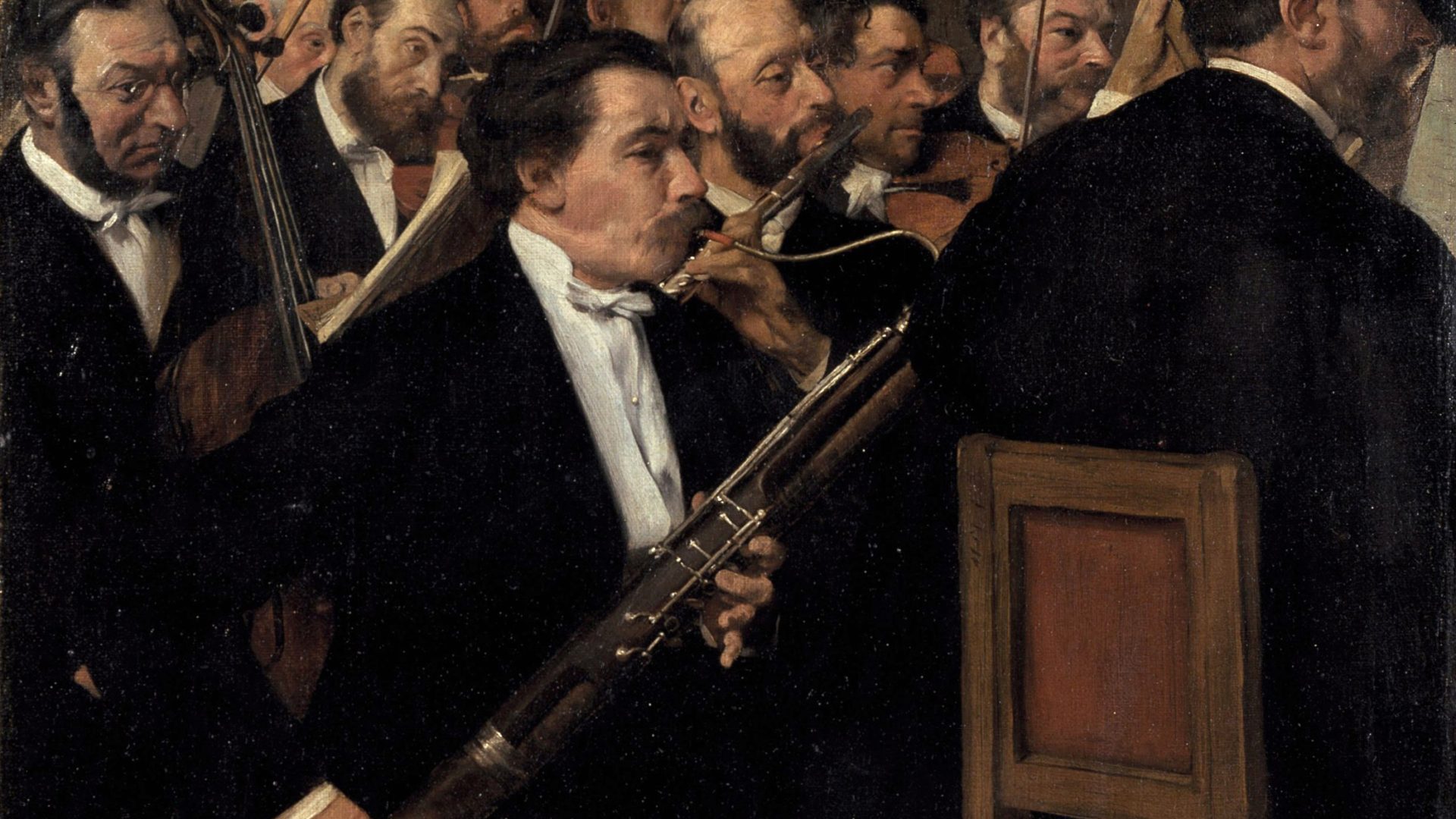
Of all the elements of music, tone color is perhaps the most immediate—and the least discussed. We recognize it before we recognize anything else. Before we have identified the melody, before we have felt the rhythm, we have already heard what is playing. A cello is not a trumpet. A chorus is not a solo voice. The difference between them is tone color.
What is tone color?
Tone color—also called timbre—is the quality of a sound that allows us to distinguish between different sources producing the same pitch at the same volume. Two instruments can play the same note with the same loudness and still sound completely different. That difference is tone color.
In the physical world, tone color is determined by the overtone series — the combination of frequencies that vibrate simultaneously whenever a note is played. Every instrument, every voice, has a unique overtone profile. But in musical terms, what matters is not the physics but the expressive consequence: tone color is the composer’s palette.
Tone color as a compositional decision
For much of Western music history, tone color was considered secondary — a vehicle for melody and harmony, not an element in its own right. The choice of instrument was largely a practical matter, not a compositional one.
That changed, gradually and then decisively. By the late nineteenth century, composers were writing music in which tone color was not a vehicle but a subject — in which the choice of instrument was inseparable from the musical idea itself.
Composers work with two fundamental possibilities: single tone colors — a solo instrument or voice, presenting a line without mixture — and mixed tone colors, in which two or more instruments or voices combine to create a new, composite sound. A string quartet is not four separate timbres heard simultaneously; it is a single, blended color that none of the four instruments could produce alone. The same is true of the symphony orchestra, which is one of the most complex instruments ever invented — a machine for the creation of mixed tone colors of almost unlimited variety. Beyond individual instruments, composers use the combination of timbres — the blending and contrasting of different tone colors — to create atmosphere, character, and meaning.
In the late Baroque, composers began writing works for solo instrument without any accompaniment — a demanding format in which a single color must sustain an entire musical discourse alone. C.P.E. Bach, working between the Baroque world of his father and the emerging Classical style, composed this sonata while serving as court harpsichordist in Berlin. In the opening movement, the flute speaks without support of any kind.
C.P.E. Bach: Sonata for solo flute in A minor, Wq. 132 – I. Poco adagio. Emmanuel Pahud, flute.
The string quartet represents a different order of complexity: four instruments of the same family, each with its own color, combining into a single blended sound that none of them could produce alone. The slow introduction to Mozart’s “Dissonance” Quartet — named for the unsettling harmonies that open it — is one of the most striking examples of what a small ensemble of mixed tone colors can achieve.
W.A. Mozart: String Quartet No. 19 in C major, K. 465 “Dissonance” – I. Adagio – Allegro. Emerson String Quartet.
The symphony orchestra represents the most complex palette of mixed tone colors available to a composer. With dozens of instruments from four distinct families, it offers a range of timbric combinations that is, for practical purposes, inexhaustible. A composer writing for full orchestra is not simply choosing which instruments play a given melody — every combination, every doubling, every contrast between sections produces a different composite color.
In the third movement of Respighi’s Pines of Rome, the orchestra creates a nocturnal scene of remarkable delicacy: muted strings establish an atmosphere, woodwinds and brass enter and recede, and the movement ends with something unprecedented — a recording of a real nightingale, played through a phonograph on stage. Respighi incorporated the sounds of nature itself into the orchestral palette, making the boundaries between composition and the world outside the concert hall briefly disappear.
O. Respighi: Pines of Rome, P. 141 – III. The Pines of the Janiculum. Giuseppe Sinopoli, Conductor / New York Philharmonic.
The human voice is perhaps the most versatile single tone color of all. Within a given vocal technique, a singer retains the ability to brighten or darken the sound, to project or to withdraw — small but meaningful variations that constitute a timbric language of their own. In Schubert’s Der Erlkönig, a single voice becomes three different characters — father, child, and the Erlking himself — each distinguished primarily by vocal color. The piano, meanwhile, does not accompany; it creates the world in which the drama unfolds.
F. Schubert: Erlkönig, D. 328. Dietrich Fischer-Dieskau, baritone / Gerald Moore, piano.
In Ravel’s Boléro, a single melody repeats seventeen times without harmonic change — the entire interest of the piece lies in the succession of tone colors that carry it, each one transforming the melody into something new.
M. Ravel, Boléro (M. T. Thomas, Conductor / London Symphony Orchestra)
This post is part of Koilon’s Music Appreciation series — an introduction to music for curious listeners of all backgrounds.